
The first American autonomous ground vehicles are fighting in Ukraine
Over 100 self-driving ATVs are operating in active combat zones right now — not in a simulation, not in a Pentagon test range, but in the mud and artillery smoke of eastern Ukraine. The first American autonomous ground vehicles are deployed in a real war, and the lessons coming back from that battle

```html
The first American autonomous ground vehicles are fighting in Ukraine
Over 100 self-driving ATVs are operating in active combat zones right now — not in a simulation, not in a Pentagon test range, but in the mud and artillery smoke of eastern Ukraine. The first American autonomous ground vehicles are deployed in a real war, and the lessons coming back from that battlefield will reshape how the world thinks about AI in physical systems. For developers and founders building in Asia, this is not a distant geopolitical story. It is a signal about where the next decade of AI investment, talent, and infrastructure is heading.
What Happened
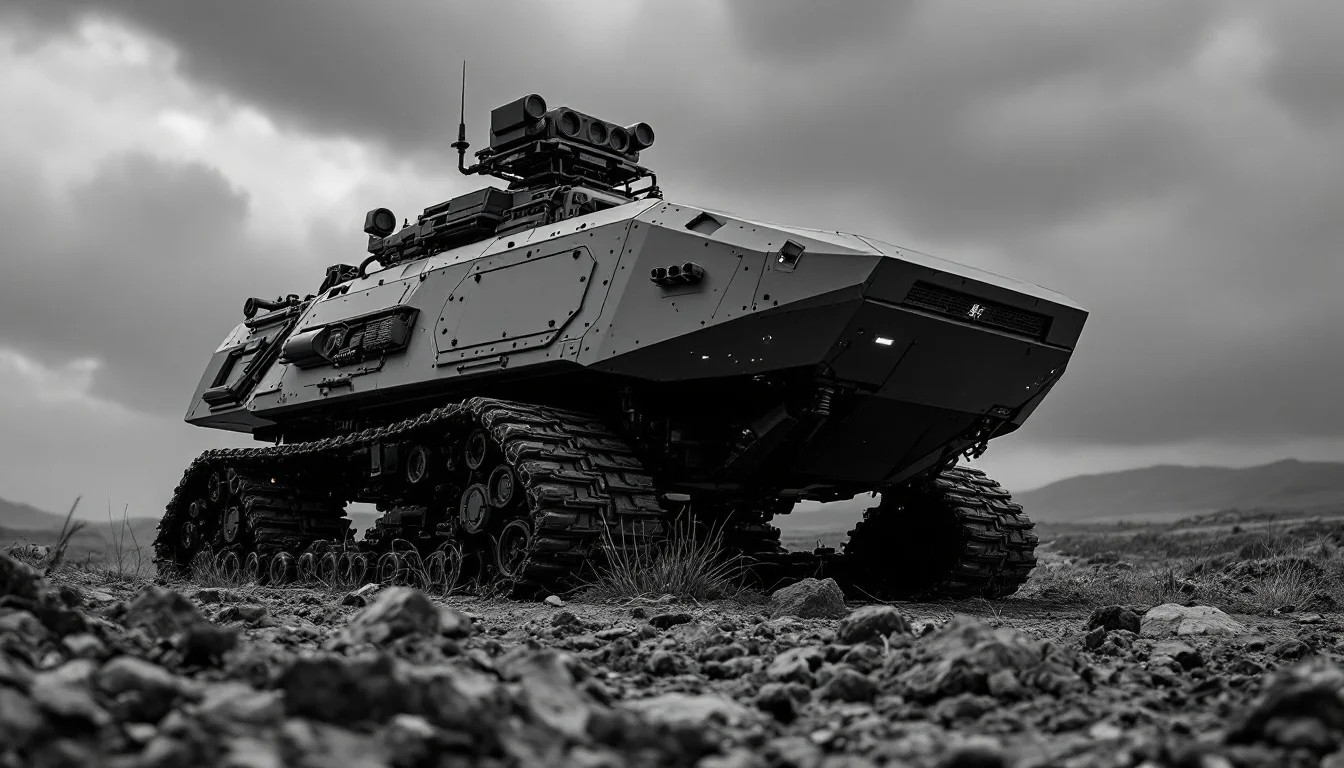
US-based autonomous vehicle company Forterra revealed on July 7, 2026 that it has deployed more than 100 of its self-driving ATVs in Ukrainian conflict zones over the past nine months. The company describes this as the largest deployment of autonomous ground vehicles in combat by any US defense tech company — a claim that, if accurate, marks a genuine inflection point in how AI-powered hardware is being tested and validated.
The deployment is funded by US defense dollars and sits within a broader effort to modernize the US military by supporting Ukrainian resistance against Russian forces. Aerial drones have dominated the headlines from this conflict, but the battlefield dynamics they created have pushed Ukrainian strategists toward ground-based autonomy. As Sergeant Major Corey Wilkens, who leads an autonomous vehicle and tactics program for the US Army, told TechCrunch: "There's nowhere to hide. You become very, very vulnerable to be attacked by first-person view drones, other sorts of drones dropping munitions, artillery, mortar, the full range of things that they have."
Ukraine already builds its own uncrewed ground vehicles (UGVs) for logistics — moving supplies, munitions, and evacuating wounded soldiers. But those are typically battery-powered and carry up to 250 kilograms. Forterra's vehicles are positioned to go further, carry more, and operate with greater autonomy in contested environments. Scott Sanders, Forterra's chief growth officer and a former US Marine officer, framed the significance plainly: "Until you hit the realities of combat, you're just not going to know." That is not a caveat — it is the entire point. Real-world deployment is the only test that counts for AI systems operating in high-stakes physical environments.
This is the first confirmed large-scale combat deployment of American autonomous ground vehicles. Whatever comes next — from doctrine to procurement to competitor responses — starts from this moment.
Why It Matters for Asia
Asia is not a passive observer of this development. The region is home to some of the world's most active autonomous vehicle research programs, the densest concentration of semiconductor manufacturing, and several of the geopolitical flashpoints most likely to drive demand for autonomous defense systems in the coming decade.
From a pure technology standpoint, the Ukraine deployment validates something that Asian robotics and AI labs have been working toward for years: that edge AI systems — models running inference on-device, without reliable cloud connectivity — can perform in genuinely adversarial conditions. GPS-denied environments, electronic warfare, unpredictable terrain, and the need for split-second decisions without human-in-the-loop confirmation. These are not hypothetical constraints. They are the operating conditions that separate a demo from a product.
South Korea, Japan, Singapore, and India all have active autonomous systems programs, both commercial and defense-adjacent. South Korea's defense industry has been developing UGVs for DMZ surveillance for years. Japan's Self-Defense Forces have been quietly expanding their robotics procurement. India's defense research organization has been testing autonomous logistics platforms. The Forterra deployment gives all of these programs something they previously lacked: a real-world benchmark and a set of failure modes that only emerge under fire.
For the venture and startup ecosystem across Southeast Asia, the signal is equally clear. Defense tech, dual-use AI, and autonomous systems are no longer niche verticals dominated by US and Israeli primes. The capital is moving, the doctrine is shifting, and the governments writing the checks are increasingly open to working with startups that can ship fast. Asian founders who understand both the technical requirements and the regional security context are sitting on a genuine opportunity — if they move before the window closes.
There is also a supply chain angle that is impossible to ignore. The chips, sensors, and edge compute modules powering Forterra's ATVs trace their origins through a global supply chain with deep roots in Taiwan, South Korea, and Japan. Asia does not just benefit from this technology shift — Asia enables it.
What This Means for Developers
The Forterra deployment surfaces a set of hard technical problems that are directly relevant to any developer building AI systems that operate in the physical world — not just defense applications, but logistics, agriculture, infrastructure inspection, and industrial automation across Asia.
Edge inference under constraint. Combat UGVs cannot rely on cloud connectivity. Every decision — obstacle avoidance, route planning, threat response — has to run locally on hardware that is power-constrained, thermally stressed, and potentially damaged. The models powering these systems are not the same large foundation models that run comfortably in a data center. They are aggressively quantized, pruned, and optimized for specific inference tasks. If you are building AI for any environment where connectivity is unreliable — a factory floor in rural Indonesia, a fishing vessel in the South China Sea, a logistics hub in a tier-3 city — this architecture challenge is yours too.
Sensor fusion at the edge. Autonomous ground vehicles in contested terrain combine data from lidar, radar, cameras, and IMUs in real time. The fusion algorithms that make sense of conflicting or degraded sensor inputs are among the hardest problems in applied AI. The Ukraine deployment will generate failure data that no lab simulation can produce. Expect that data — or at least the architectural lessons from it — to flow back into open research and commercial products over the next two to three years.
Human-machine teaming interfaces. These vehicles are not fully autonomous in the sense of operating without any human oversight. Operators monitor and can intervene. Building the interface layer that lets a human understand what an autonomous system is doing, trust it appropriately, and override it cleanly when needed is a UX and systems design problem that most AI teams underinvest in. The military is learning hard lessons about this right now. Commercial AI teams should be paying attention.
Simulation-to-reality gaps. Sanders' comment — "until you hit the realities of combat, you're just not going to know" — applies directly to AI development more broadly. Simulation is necessary but not sufficient. The gap between a model that performs well in a controlled environment and one that holds up in production is where most AI projects fail. Building workflows that close this gap faster — tighter feedback loops, better telemetry, faster iteration cycles — is the core engineering challenge of the decade. Platforms like MonstarX are built around exactly this kind of accelerated, AI-native development cycle, where the distance between an idea and a deployed, tested system is measured in hours rather than sprints.
Regulatory and ethical frameworks. Deploying autonomous systems in high-stakes environments — whether military or civilian — requires navigating frameworks that are still being written. Asian developers building in this space need to engage with regional regulatory bodies early, not after the product is built. The EU AI Act and US DoD's autonomous weapons policies are setting precedents that will influence Asian regulators. Get ahead of it.
Key Takeaways
Strip away the geopolitical context and the core message is straightforward: AI systems that operate in the physical world have graduated from the lab. The first American autonomous ground vehicles are not a prototype or a press release — they are a deployed fleet with nine months of real-world operational data behind them. That changes the baseline for what "production-ready" means in autonomous systems.
For Asian developers and founders, the practical implications are:
- Edge AI is the frontier. Cloud-dependent AI is table stakes. The hard problems — and the defensible products — are in systems that work without connectivity, at low power, on constrained hardware. Invest in this stack now.
- Real-world data beats simulation data. Every AI team building physical systems needs a strategy for closing the sim-to-real gap. This means instrumented deployments, fast feedback loops, and willingness to ship imperfect systems into controlled real-world environments to learn.
- Dual-use AI is a genuine market. Technologies built for logistics, inspection, or agriculture have direct defense applications, and vice versa. Asian founders who understand both markets can access capital and contracts that single-use competitors cannot.
- The supply chain advantage is real but temporary. Asia's role in enabling autonomous systems hardware gives regional players a window of leverage. That window will not stay open indefinitely as onshoring efforts accelerate in the US and Europe.
- Iteration speed is a moat. The teams that will win in autonomous systems are not necessarily the ones with the best models today — they are the ones that can learn from deployment data and ship improvements faster than anyone else.
Ukraine is not just a conflict zone. For AI developers paying attention, it is the most demanding test environment on earth — and the results are starting to come in.
```